Migrateful
Philanthropic support has helped a charity which runs cookery classes for the public taught by refugees and migrants to go from an idea to a thriving social enterprise.
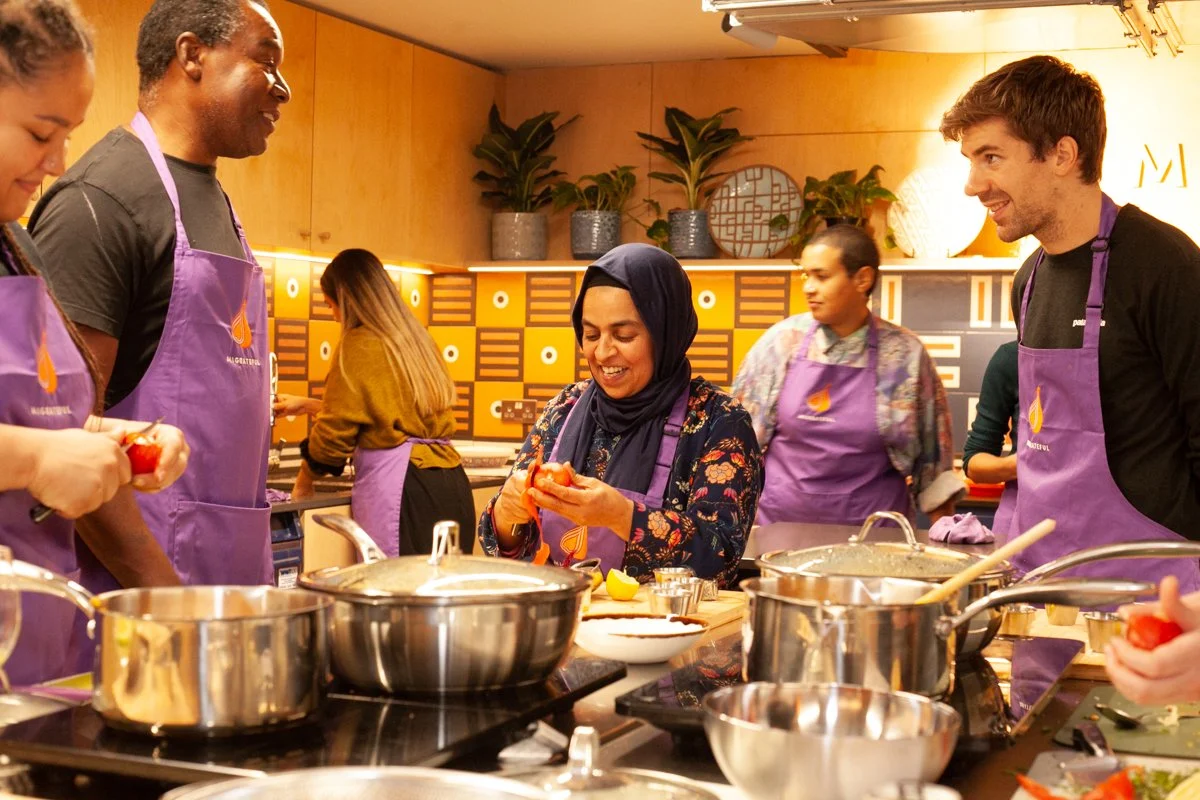
Moroccan chef Zineb and participants. (Image credit: Migrateful).
Back in 2017, Jess Thompson was teaching an English class in London’s Tower Hamlets when she found herself talking to a group of refugee women about the challenges they faced. Many of them, it turned out, were highly qualified in their own countries, but were unable to get work in the UK because their qualifications were not recognised and they struggled with language barriers.
The class Jess was teaching was part of a skills exchange, where participants could get free English lessons in return for sharing with the group a skill of their own. When Jess asked these women, who came from 15 different countries, what skill they wanted to share, she was struck that they all said the same thing: cooking. And the idea for Migrateful was born.
Migrateful’s mission is to help asylum seekers, refugees and other migrants overcome the barriers they face when trying to integrate into the UK, and to build a more welcoming and inclusive society. And it does this using the tried-and-tested method of getting to people through their stomachs. The charity offers a 12-week foundation level chef training programme for migrants, who then stay with the charity for a further two years as instructors, teaching cookery classes to people who want to learn to cook different cuisines from around the world. This allows the organisation to run a social enterprise model, where around 65% of the income needed to fund its work comes from people paying for classes.
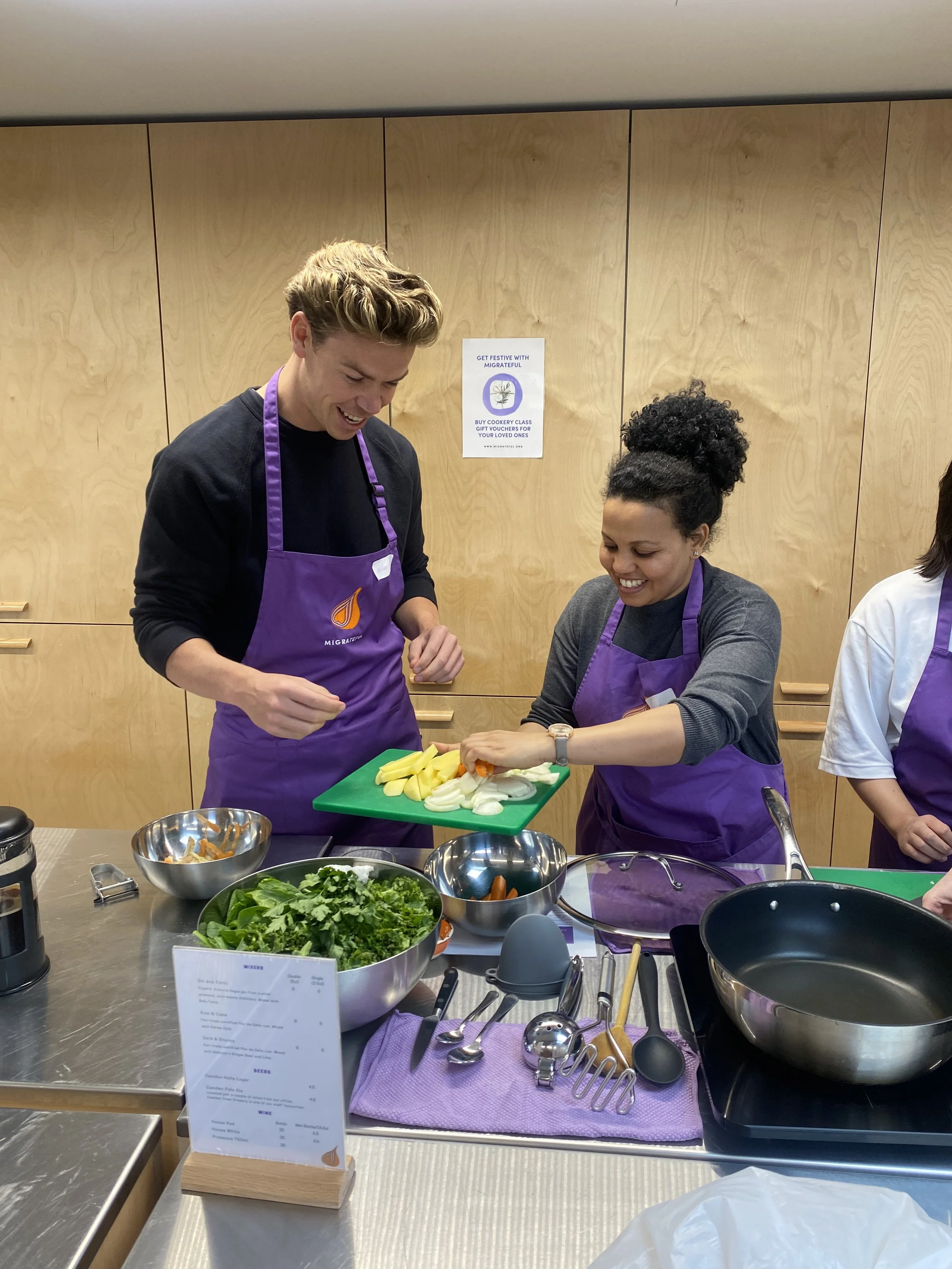
Actor Will Poulter taking part in a Migrateful cookery class. (Image credit: Migrateful)
But as well as being a source of revenue, the classes are also a vital part of achieving Migrateful’s mission. They reflect the organisation’s belief in the importance of “contact theory” – i.e. the idea that if you bring people from different backgrounds together in a context where they have equal status and are working towards a collective goal, this can successfully overcome mistrust and prejudice. This theory seems to have been borne out in practice, too. To date, Migrateful has trained 1263 chefs from around the world and organised over 5,6500 cookery classes across its sites in London, Bristol, Margate, Canterbury and Brighton. This has seen more than 664,000 participants engage with the charity, as well more than 3,600 volunteers who help to run the classes.
Whilst having a social enterprise model has been important in ensuring that Migrateful is sustainable, philanthropy has also played a crucial part in its development. In 2021, the charity successfully raised £200,000 via a crowdfunding campaign to secure its first permanent base in London, and it has also developed valuable relationships with a number of individual philanthropists. Key to success here has been storytelling. As Jess Thompson notes, “when it comes to attracting high net worth individuals, I guess you could say the strategy has been PR.” This is something Migrateful has been particularly good at: using the stories of the individual chefs they have worked with and the evidence they have gathered of the wider impact of their work to secure media coverage across TV, radio and newspapers, as well as valuable endorsements from the likes of celebrity chefs Jamie Oliver and Yotam Ottolenghi and the actor Will Poulter (who starred in the hugely successful TV show The Bear).
It is this widespread coverage, rather than more traditional fundraising, that has led to philanthropic support. One high net worth donor, for instance, got in touch with the charity after hearing Jess talk on BBC Radio 4’s Food Programme and ended up giving them £100K of core support every year for 6 years. Another came across one of Migrateful’s posts on Instagram and is now giving them another £100K per year. And just recently, a donor found out about the charity’s work via TikTok and has made an £60K initial donation to the charity, in the hope of developing a longer-term funding relationship.

This support has been vital in helping Migrateful to cover its core costs, whilst at the same time being able to grow and build on the organisation’s success. It has also contributed directly to the charity being able to deliver on its mission. It has always been an important part of the organisation’s ethos, for example, to work with migrants who currently have no legal right to work as well as with those who do. However, this would be very difficult if the only option for supporting people was through paying them salaries (as those people would, by definition, not be eligible). But thanks to the philanthropic support the charity has received, it is able to offer small destitution relief grants to people who currently have no right to work, so that they can take part in training while they wait for their asylum claims to be approved.
The impact on the lives of the chefs Migrateful has worked with has undoubtedly been huge: 82% of them, for example, have gone on to employment or education. This includes Awa, from the Gambia, who became head chef at Comptoir Libanias in Chelsea (and won the title of best chef across their chain of restaurants), and Yogi from Sri Lanka, who now works at the Park Plaza Hotel. Almost all participants reported significant benefits in terms of improved language skills and confidence too, and many of them spoke about the value of the sense of belonging and acceptance they had developed through the training and through teaching cookery classes. As Habib from Afghanistan explains:
“The social experience of teaching the classes was a really great way to address my loneliness. The classes allowed me to meet British people, which I really values as I am going to live in this country for the rest of my life… Migrateful has been like a family to me, it filled me with love, it was a place where I could belong and people made me feel so valued and trusted. I had to leave behind my family so it was important for me to find a new one.”
At a time when attitudes to migration are becoming more and more polarised, Jess believes that Migrateful’s work offers a real opportunity for people to combat negativity and to feel a sense of agency:
“It’s a positive news story in an otherwise quite bleak landscape, so I think people are attracted to the hopefulness of it. And food is just a powerful way for humans to connect.”