DFN Project SEARCH
Long term support from a donor with deep personal commitment is helping to transform employment opportunities for young people with SEND needs.

Attendees at DFN Project Search’s annual conference in 2024. (Image credit: DFN Project Search)
Support for special educational needs and disabilities is facing a crisis in the UK right now. So much so that, according to the Institute for Fiscal Studies, “the system is broken….Costs are spiralling, the quality of provision is patchy, and almost everyone involved – schools, councils, parents and children – is at breaking point.”
In part this is because the scale of need has grown enormously over the past decade: since 2018, the number of pupils with Education, Health and Care Plans (EHCPs) – legal documents guaranteeing tailored support for individual pupils judged to have the most severe needs – has increased by nearly 80%. Yet at the same time, levels of funding have failed to keep pace.
For pupils with special needs and disabilities, this present major challenges. Many struggle to find suitable provision, and a significant proportion end up with long-term absences or falling out of schooling altogether. And even those that do manage to find suitable primary and secondary education often face a whole new set of challenges when it comes to the transition to the workplace. As a result, only 4.8% of adults with SEND needs are currently in paid, permanent employment in the UK, compared to around 54% of disabled people as a whole, and around 75% of the general population.
DFN Project SEARCH is working hard to buck this trend. It provides a program of supported internships for young people with SEND needs, to help them learn about the workplace and develop the skills and confidence they need to flourish in future.
The charity came about in 2018, thanks to the efforts of the philanthropist David Forbes-Nixon. His experience with his own son’s special educational needs had given him insights into the challenges facing young people with SEND, and led him to create the DFN Foundation. At first this was primarily as a way of supporting the Undershaw School in Surrey, where his son was a student, but over time David came to realise that the challenges didn’t end when these students finished school: in fact, they often got worse. So he began to wonder what more he could do to help address the transition from school to employment for young people with SEND. Rather than reinventing the wheel, David decided to look around for existing solutions that could be replicated, and in 2018 bought the rights to bring the successful Project SEARCH approach of offering supported internships, which had been pioneered at Cincinnati Children’s Hospital in the 1990s, to the UK.

Participants in DFN Project Search’s Youth Parliament. (Image credit: DFN Project Search).
DFN Project SEARCH’s programme is open to young people aged 16 to 24 with a learning disability or autism spectrum condition, or both. Participants remain enrolled at their school or college but are then based full-time within a host business, where they receive up to 800 hours of structured on-the-job learning, supported by teachers, job coaches, managers, and mentors. And the programme is able to offer internship opportunities with a wide range of well-known private and public sector partners: including Amazon, ASDA, the NHS, Goldman Sachs, and Marriott Hotels.
In addition to delivering its flagship programme, DFN Project SEARCH also does other work to deliver on its mission. For example, using the data and insights it has built up to engage with policymakers – so that it might be able to inform government policies and thus help reduce the barriers faced by young people with special educational needs or disabilities in the future. Or creating a National Supported Internships Day, to spread awareness about the benefits that these kinds of opportunities can bring.
The charity’s ambition is for every young adult who takes part to transition to meaningful paid employment (preferably full time or at least 16 hours per week). Whilst that is a high benchmark, the charity is performing well against it: to date it has worked with over 2,000 young people, with an average of 63% securing permanent, paid roles. And for those that do complete the programme successfully, like 20 year old Juned, the impact can be transformational:
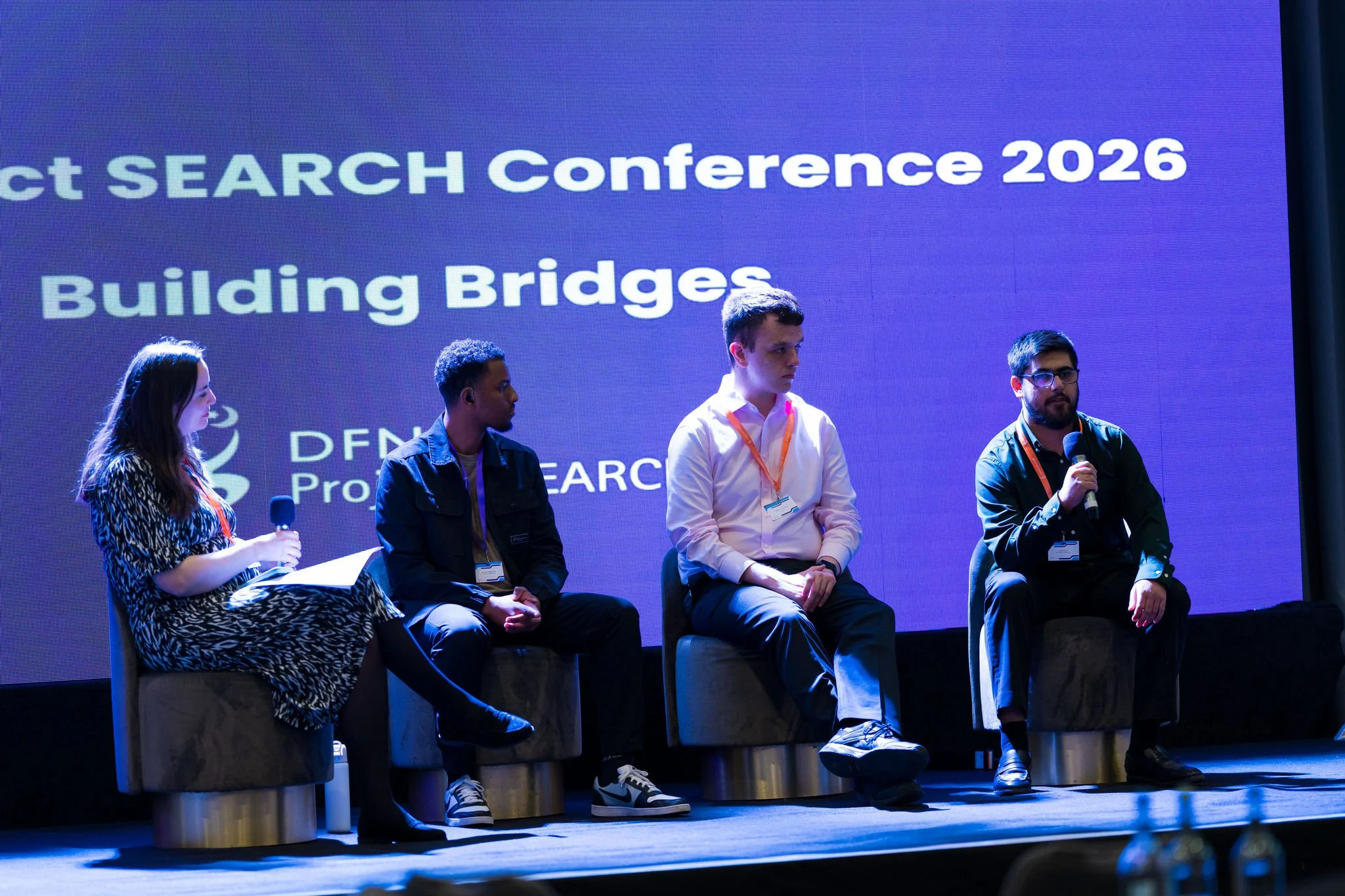
Interns at DFN Project SEARCH Conference. (Image credit: DFN Project Search).
“DFN Project SEARCH has completely changed my life. At first, my mum was reluctant at first about me starting the internship, but when she saw how well I was doing, she was proud. Now, I earn my own money. I don’t have to ask my family for things like I did when I was younger. If I want to buy a video game, food or nice clothes, I can just go out and get it. I can also contribute in my family and pay for holidays or go to live sporting events…. I can’t believe where I am now—I’ve kickstarted my career from the age of 18, and I’m thriving.”
The challenges facing young people with SEND needs in the UK remain deep-seated and systemic, and there is clearly a lot more work to be done. Philanthropy cannot do this work by itself, but the example of David Forbes-Nixon and the work of DFN Project SEARCH shows what can be achieved when personal experience and long-term commitment to a cause combines with a proven, evidence-based approach. And perhaps this can in turn provide a template for other philanthropists - and for government - to build on, so that one day all young people with SEND needs are able to realise their full potential.