Pears Cumbria Medical School
A £5 million gift from the Pears Foundation has enabled the creation of a new medical school in Cumbria, and a new model for overcoming the UK’s chronic health inequalities.
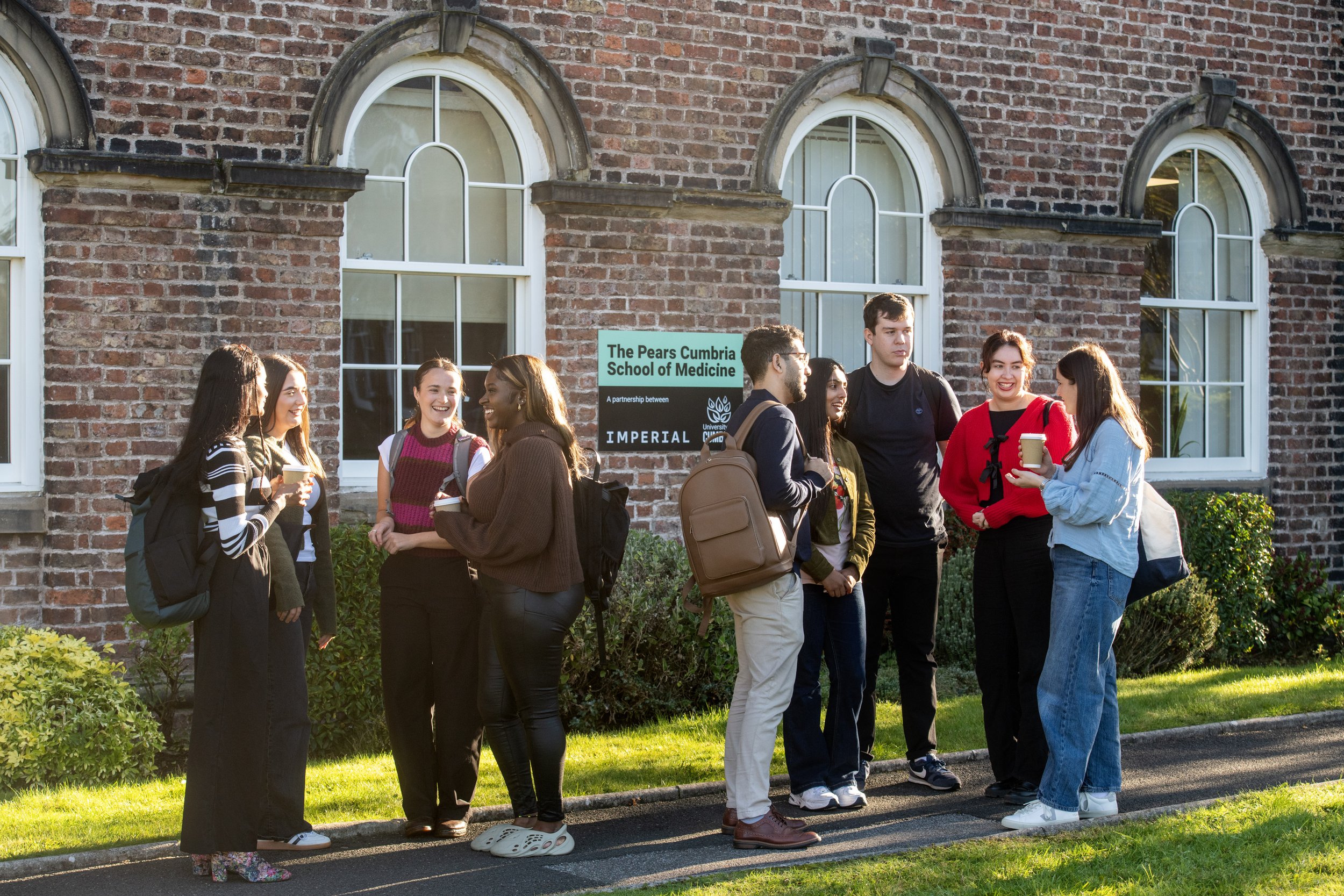
Pears Cumbria School of Medicine students at Fusehill St campus. (Image credit: Pears Cumbria School of Medicine).
Despite being only a small island, the UK contains some stark health inequalities. If you travel from South Kensington in London, for instance, to the North-West coast of Cumbria, the average life expectancy will drop by 15 years.
Professor Martin Lupton, Vice-Dean for Education at Imperial College London, was keenly aware of this. He also knew that a sizeable body of research shows that medical schools and medical education are a powerful tool for addressing these kinds of challenges; delivering improvement in health outcomes and bringing significant additional value for every pound invested. What if, he therefore wondered, a prestigious institution like Imperial College – which normally focusses its attention on the national and international level – were to use its position to help create a new kind of regional medical school in the UK?
Cumbria quickly emerged as the obvious place to do something, since it was a clear black spot in terms of both research and medical education, so there was real potential for a new medical school to have a significant impact. But rather than start from scratch, Martin was keen to see if there were existing partners Imperial could work with – as this would give their plans greater legitimacy in the region, and also help to keep start-up costs down. This may sound like little more than common sense, but in the university sector – where institutions are generally pitched against each other in a fierce battle for students and resources – collaboration is often not the first thing on people’s minds.
Martin reached out to the University of Cumbria, however, and it quickly became apparent that this was both appetite and opportunity for a partnership. Although both institutions already had medical schools of their own, their focus is very different: Imperial is highly international and renowned for its research, but doesn’t provide a wide range of medical training; Cumbria, meanwhile, is strongly regional in its approach, with little research but a wide variety of training (it is the largest centre of training in the UK for paramedics, for example). This meant that it would be possible for the two institutions to work together in a way that was genuinely complementary.
It was also important for the new medical school to have a bold vision and ambition, since, for Martin Lupton, “our primary purpose is not the development of doctors. It is changing the health outcome of Cumbria”. This meant thinking from the outset about how the school’s impact in the region could be maximised. It would be important, for instance, to develop research capacity – not just because that could help to shed further light on health challenges within Cumbria, but because it would help to ensure that the region was able to attract and retain ambitious young medical professionals who wanted to continue research alongside their medical practice. It was also realised quite quickly that there were things specific to the Cumbria context that might be needed: driving lessons for students who could not already drive a car, for examples, to reflect the fact they would need to be able to make their own way around an area where public transport can be sporadic.

PCSM Launches 26 August 2025. (Image Credit: Craig Bennett, Quokka Media).
To turn this ambitious vision into reality, of course, would require money. Which is where philanthropy comes in. The capital costs were nowhere near as high as they would have been if starting from scratch, but around £5 million was still going to be needed to cover the costs of refurbishments, curriculum development and staff recruitment for the new school. And Martin is clear that the only option was philanthropy:
“The only way we could kick-start this idea was through philanthropy. We couldn't go and get a loan because banks don't lend us money for that kind of thing. So the only way was to find someone who felt that the idea was sufficiently valuable that they would give us money to make it happen. And the only funder we found that was interested in supporting an idea into fruition without having to have a new building or something physical was the Pears Foundation. With the gift from them, the idea was facilitated; and without it, it would never have started.”
For Sir Trevor Pears, Executive Chair at the Pears Foundation, supporting the new medical school made total sense:
“It is one of the great advantages of being a family foundation that we can take the long view and make long-term investments in initiatives that we believe will have meaningful impact. The Pears Cumbria School of Medicine is a great example of this. We believe it will put Cumbria in the vanguard of the way that this country thinks about the training and recruitment of doctors, whilst ensuring they are placed where they are most needed. I feel incredibly strongly that this is nothing less than Cumbria deserves."
The Pears Cumbria Medical School welcomed its first cohort of students in 2025, but even at this early stage it is having an impact on medical care in the region. Not long ago, for instance, the West Cumberland Infirmary had a 50% vacancy rate for consultants, so was forced to rely heavily on locum doctors. Recently, however, it has been able to recruit four highly-rated young orthopaedic consultants, thanks to the presence in the region of a facility that will allow them to combine their medical duties with research opportunities. Local NHS Trusts have also seen an increase in recruitment, and a programme has even been begun to reopen closed general practices along Cumbria’s Northwest Coast – an area that has long suffered from particular challenges. The hope is that in future years at least some of the graduates from the medical school will choose to stay in Cumbria too, which will further help to improve medical care and tackle health inequalities in the region.
If this early success continues, Pears Cumbria Medical School may also become a template for how to approach the UK’s wider challenges around health inequalities by taking a distinctively regional approach and harnessing the power of philanthropy to help turn ideas into reality.